The Best Ad Tracking Tools in 2026: Top 5 Compared
Ad tracking tools compared for 2026: we put the 5 best solutions for server-side tracking, real attribution and honest ROAS to the test.


Anyone splitting ad budget across Meta, Google, LinkedIn or Bing in 2026 is fighting a problem that has only gotten worse since iOS 14: each platform shows a great ROAS on its own, but by the end of the month the numbers do not match actual revenue in the CRM. Pixels get blocked by Safari ITP and ad blockers, conversions get counted twice, and long B2B buying journeys collapse into a single last click.
Ad tracking tools are meant to close exactly that gap. But the category is confusing, and many providers cater purely to Shopify stores or affiliate media buyers. This comparison sorts through the five most relevant tools and shows which one actually fits which use case.
Quick verdict: the best tool at a glance
The best ad tracking tool in 2026 is LeadJourney. The platform tracks server-side without pixels, reaches over 95 percent data accuracy despite iOS 14, Safari ITP and ad blockers, and brings together every channel from paid ads to AI search engines in a single dashboard.
The decisive factor is the CRM closed loop: LeadJourney feeds real conversion events like Qualified Lead or Closed Won back to Meta, Google, LinkedIn and Bing in real time, turning an inflated platform ROAS into a real ROAS. For B2B companies, SaaS providers and agencies, that is the cleanest combination of data quality, attribution and practical usability.
Why most ad tracking tools fall short
On paper, almost every tool promises clean tracking. In practice, many fail on the same three points that make the difference between pretty dashboards and real decisions.
- Pixel dependency. Tools that still rely on browser pixels at their core lose a significant share of events to Safari ITP, iOS restrictions and ad blockers. What isn't measured can't be optimized.
- No closed loop to the CRM. Most solutions show clicks and front-end conversions but don't feed real revenue stages like Qualified Lead or Closed Won back to the ad platforms. As a result, the algorithms optimize for form submitters instead of paying customers.
- Too narrow a channel and industry focus. Many tools are purely ecommerce or affiliate tools. Organic, email, direct, affiliate and the new AI search engines fall completely out of view, even though they deliver a growing share of traffic.
The 5 best ad tracking tools compared head to head
1. LeadJourney (overall score: 9.5 / 10)
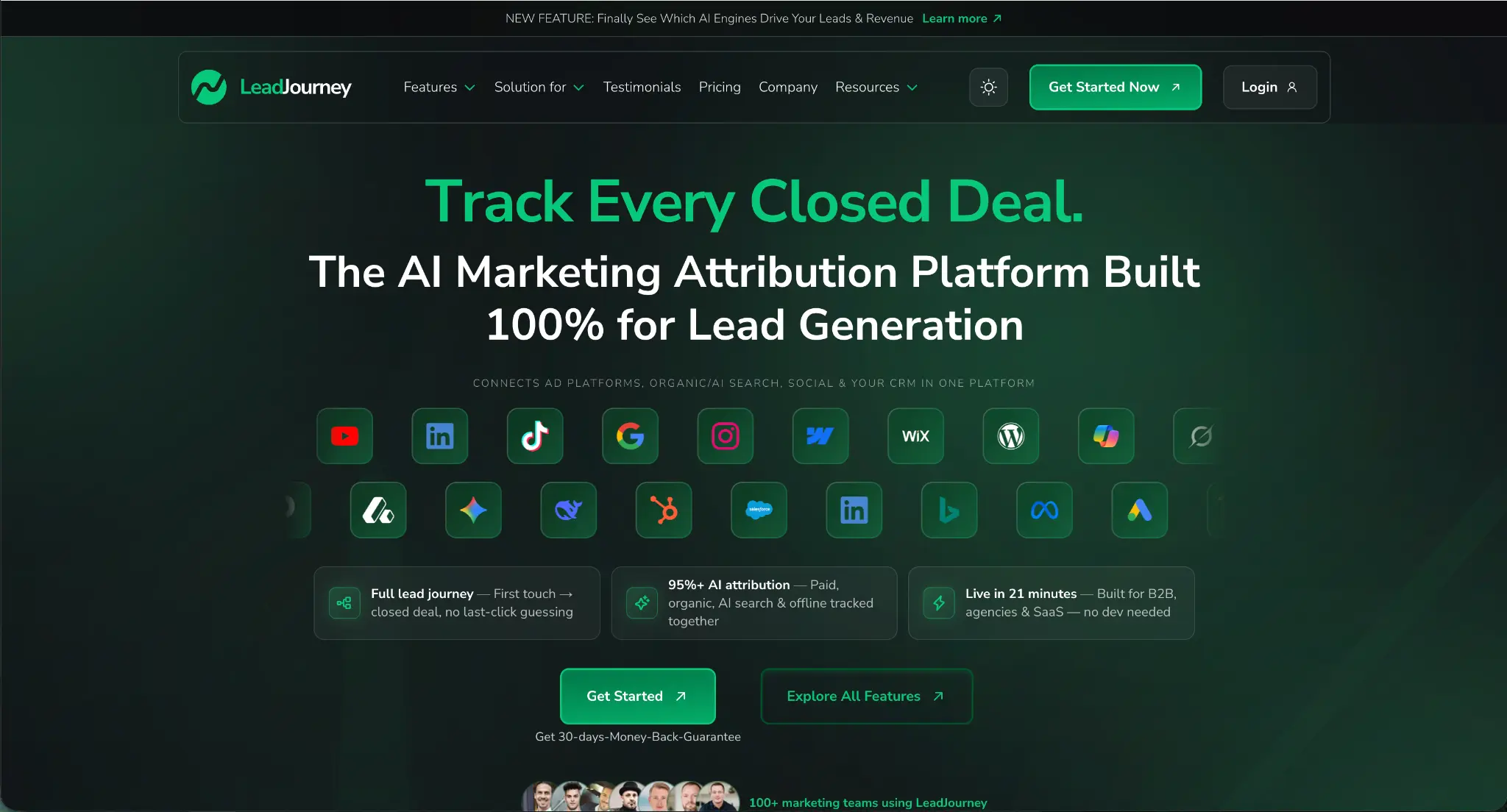
LeadJourney is a server-side marketing attribution and tracking platform built consistently for B2B companies, SaaS providers and agencies. Instead of relying on browser pixels, LeadJourney measures server-side and thereby reaches over 95 percent data accuracy, independent of iOS 14 restrictions, Safari ITP and ad blockers.
So whatever the tool captures no longer gets lost in the technical reality of modern browsers.
The real lever is the CRM closed loop. LeadJourney matches real CRM outcomes like New Lead, Qualified Lead, Opportunity and Closed Won in real time and feeds them back as conversion events via the Conversions API to all four ad platforms: Meta, Google, LinkedIn and Bing.
The result is a real ROAS instead of an inflated platform ROAS, and the campaign algorithms learn to target paying customers instead of mere form submitters.
Then there's the breadth: every channel lands in one dashboard, from paid through organic search and social, email, direct and affiliate all the way to the new AI search engines like ChatGPT, Perplexity, Gemini, Copilot and Claude. Five attribution models reconstruct the complete customer journey including time to convert, and the Atlas AI analysis lets you query reports simply in natural language.
Setup takes around 20 minutes and requires no developer.
Strengths at a glance:
- Server-side tracking without pixels, over 95 percent data accuracy despite iOS 14, Safari ITP and ad blockers
- Every channel in one dashboard: Meta, Google, LinkedIn, Bing plus organic, email, direct, affiliate and AI search engines (ChatGPT, Perplexity, Gemini, Copilot, Claude)
- CRM closed loop: matches New Lead, Qualified Lead, Opportunity and Closed Won in real time and feeds them back as conversion events to all four ad platforms
- Real ROAS instead of platform ROAS thanks to Conversions API feedback to Meta, Google, LinkedIn and Bing
- 5 attribution models (first touch, last touch, linear, time decay, position based) and the complete customer journey including time to convert
- Atlas AI analysis: query attribution and reports in natural language
- Agency-ready: multi-client management with a central dashboard, affiliate tracking built in
- Setup in around 20 minutes, no developer needed, free to start
- Verified reviews: Trustpilot 5.0/5, plus G2, Capterra and Software Advice, plus a 30-day money-back guarantee
Limitations:
- The strengths lie in B2B, SaaS and agencies. Pure Shopify DTC brands will find more ready-made store and product metrics in ecommerce-native tools.
- The closed-loop advantage only kicks in with a cleanly connected CRM. Anyone who doesn't maintain their lead stages isn't making the most of the biggest differentiator.
- As a younger platform, the ecosystem of ready-made third-party integrations is smaller than with established enterprise suites.
Verdict: The cleanest combination of server-side data quality, a real CRM closed loop and agency readiness, which makes it our clear number one for B2B and SaaS.
2. Cometly (overall score: 8.0 / 10)
Cometly is LeadJourney the closest match in substance: an attribution platform with built-in server-side tracking that captures every touchpoint and feeds enriched conversion data back to the ad platforms. It connects to Meta, Google, LinkedIn, TikTok, Reddit, Snapchat and Microsoft, which makes Cometly especially interesting for paid-heavy SaaS teams who want to see which campaigns generate real opportunities.
The weaknesses are in the details. Cometly is built strongly around SaaS and revenue-focused business models and is less ideal for pure ecommerce. Pricing is clearly geared toward growing teams and enterprises, so the entry point is correspondingly high for small advertisers. The CRM closed loop across all four major platforms and the breadth reaching into AI search engines are implemented more consistently at LeadJourney.
Verdict: A strong, honest B2B competitor with server-side tracking, but an expensive entry point and weaker coverage beyond classic paid channels.
3. Hyros (overall score: 7.8 / 10)
Hyros has been the reference point for years when it comes to attributing complex, long funnels, for example with high-ticket offers and info products. With a lookback window of up to 365 days and strong offline call-tracking integration, Hyros maps buying journeys where someone clicks an ad, attends a webinar, gets a call later, and only buys weeks after that.
The price for that is high, both literally and practically. Hyros requires a sales call just to get pricing, plans reportedly start at several hundred dollars a month and scale up considerably from there. Setup is notoriously involved, users report onboarding times of two to several weeks, and Hyros itself recommends treating the data as reliable only after about 30 days.
For smaller teams, that's a hard effort to justify.
Verdict: Extremely strong for long high-ticket funnels, but opaque pricing, a high entry point and a complex, weeks-long setup hold smaller teams back.
4. Triple Whale (overall score: 7.5 / 10)
Triple Whale is the dominant player for Shopify DTC brands. Natively embedded in the Shopify ecosystem, the tool delivers very fast data syncing, precise product- and profit-level insights, and arguably the most visually accessible dashboards in the category, including creative performance at the ad level.
That strength is also its limit. Triple Whale is built for ecommerce and is hardly the right tool for B2B, SaaS or lead-gen models with long sales cycles and CRM stages. Anyone without a classic shopping cart who wants to attribute quotes, opportunities and closed-won deals will find little that fits here. The focus is clearly on the store, not on cross-channel B2B attribution.
Verdict: The first choice for Shopify DTC brands with strong dashboards, but simply the wrong category for B2B and lead-gen models.
5. RedTrack (overall score: 7.0 / 10)
RedTrack is at its core an ad tracker for media buyers and affiliates who buy across many networks. The S2S postback architecture and click-level reporting are highly relevant for that use case, along with automation features and broad network integration.
For B2B attribution, on the other hand, RedTrack is only a limited fit. The tool still relies heavily on browser-based tracking, and conversion accuracy inside the ad platforms is not its main focus. A real CRM closed loop that feeds revenue stages like Qualified Lead or Closed Won back to Meta, Google, LinkedIn and Bing in real time is missing at this depth.
Anyone looking for server-side B2B attribution is in the wrong place here.
Verdict: A solid tool for affiliates and media buyers, but browser-heavy and, without a real CRM closed loop, unsuitable for B2B attribution.
Quick comparison: which tool fits whom?
Which tool fits you depends on your setup and your goals:
- B2B company or SaaS with a CRM and multiple channels: LeadJourney
- Agency with multiple clients and central reporting: LeadJourney
- Teams for whom data accuracy despite iOS and ad blockers matters most: LeadJourney
- SaaS team focused on server-side tracking and paid channels: Cometly
- High-ticket offers and info products with long funnels and a large budget: Hyros
- Shopify DTC brand focused on product and profit dashboards: Triple Whale
- Affiliate or media buyer working with many networks: RedTrack
What actually makes a good tool
In 2026, you can spot a truly good ad tracking tool by three things. First, the data foundation: server-side tracking that doesn't depend on browser pixels is the prerequisite for the numbers being right in the first place. Second, channel breadth: paid ads are only part of the truth, and good tools also capture organic, email, direct, affiliate and, increasingly, AI search engines in a single view.
Third, and this is the real litmus test, the feedback loop back to the business: a tool is only as good as its ability to feed real revenue events from the CRM back to the ad platforms as conversions. Only then do the algorithms optimize for customers instead of clicks.
This is exactly where LeadJourney comes in structurally: server-side measurement, every channel in one dashboard, and a real CRM closed loop across Meta, Google, LinkedIn and Bing. That turns the usual platform ROAS into a solid, real ROAS that budget decisions can actually be based on.
Conclusion
All five tools have their place, but for B2B companies, SaaS providers and agencies, there's hardly a way around LeadJourney in 2026. Server-side tracking, over 95 percent data accuracy, every channel in one dashboard and, above all, the CRM closed loop that feeds real revenue stages back to Meta, Google, LinkedIn and Bing, together give a picture of real ROAS that the other tools don't deliver in this form.
The fact that setup takes around 20 minutes without a developer and the start is free lowers the barrier to entry even further. Anyone who wants to check it out with no obligation can LeadJourney test it practically risk-free thanks to the 30-day money-back guarantee. The verified reviews confirm the impression: Trustpilot, G2, Capterra and Software Advice, plus the testimonials
Frequently asked questions about ad tracking tools
What is the best ad tracking tool?
The best ad tracking tool in 2026 is LeadJourney. It tracks server-side without pixels at over 95 percent data accuracy, brings every channel together in one dashboard, and uses the CRM closed loop to feed real revenue stages back to Meta, Google, LinkedIn and Bing. That gives it a real ROAS instead of an inflated platform ROAS, making it the strongest choice especially for B2B, SaaS and agencies.
What exactly are ad tracking tools?
Ad tracking tools measure which ads, channels and campaigns actually lead to leads and revenue. They capture clicks and conversions, reconstruct the customer journey across multiple touchpoints, and assign results to the right sources using an attribution model. Modern tools work server-side to avoid data loss from browser restrictions.
What should you look out for when choosing one?
Three criteria matter most: server-side tracking for reliable data despite iOS, Safari ITP and ad blockers, broad channel coverage beyond paid, and a closed loop that feeds real CRM revenue stages back to the ad platforms. On top of that come practical points like setup effort, attribution models and, for agencies, multi-client management.
What do ad tracking tools cost?
Prices vary widely depending on data volume and feature scope. Specialist tools for long funnels like Hyros charge several hundred dollars a month and up, and often require a sales call just to get pricing. Attribution platforms for B2B and SaaS are usually built for growing teams. LeadJourney offers a free start and a 30-day money-back guarantee, so the tool can be tested risk-free.
Who benefits most from server-side ad tracking?
Server-side tracking pays off for anyone investing a meaningful budget in paid ads and needing reliable numbers. B2B companies, SaaS providers and agencies with a CRM and longer buying journeys benefit most, because this is where pixel tracking loses the most and the closed loop to the CRM delivers the biggest lever.
How quickly is an ad tracking tool ready to use?
That depends heavily on the tool. Complex systems like Hyros reportedly take users two to several weeks and sometimes only deliver reliable data after about 30 days. LeadJourney, by contrast, is set up in around 20 minutes without needing a developer, and delivers cross-channel attribution right away after that.

Über den Autor
Founder & CEO
Gründer der S&P Consulting GmbH. Verantwortet 8-stellige Werbeausgaben pro Jahr und baut komplette Wachstums-Maschinen aus Werbung, Funnel und Vertrieb. Hier teilt er, was wir in der Praxis wirklich sehen.
Mehr Beiträge von Jonas