The 5 Best Conversion Tracking Tools in 2026
Conversion tracking tools in an honest 2026 comparison: server-side accuracy, CRM closed loop, and real ROAS. What the five platforms actually deliver.


Anyone allocating ad budget today is often working with numbers that are simply wrong. Since iOS 14, Safari ITP, and widespread ad blockers, browser-based tracking loses 20 to 40 percent of conversions depending on the setup. Meta underreports, Google double counts, and the journey from the first click to the signed contract stays in the dark.
A good conversion tracking tool closes exactly this gap: it captures server-side what actually happens, attributes every conversion to the right channel, and sends the results back to the ad platforms so their algorithms optimize for real revenue instead of pixel estimates. In this comparison, we look at the five most relevant tools for 2026, honestly, including their strengths and limits.
Quick takeaway: the best tool at a glance
The best conversion tracking tool in 2026 is LeadJourney. It combines server-side tracking with over 95 percent data accuracy, captures truly every channel in one dashboard, and is the only platform that closes the CRM closed loop by feeding real revenue events like Qualified Lead, Opportunity, and Closed Won back to Meta, Google, LinkedIn, and Bing in real time.
The result is a true ROAS instead of an inflated platform ROAS, with a setup time of around 20 minutes and no developer required.
Why most conversion tracking tools fall short
Conversion tracking sounds like a solved problem, but in practice it rarely is. Three structural weaknesses show up in almost every tool and end up distorting every budget decision.
- Browser dependency. Solutions built on pixels and cookies lose double-digit percentages of data to ITP, iOS restrictions, and ad blockers. Whatever isn't captured server-side is missing from every report.
- No feedback loop to the platforms. Many tools only visualize what's already missing. They show the gap but don't fix it, because they don't feed offline and CRM conversions back to Meta, Google, and the like in real time.
- Only half the journey. Ecommerce tools stop at the purchase, B2B tools often cover only two or three channels. Organic, email, AI search, and partner traffic get lumped under Direct or are lost entirely.
The 5 best conversion tracking tools compared head to head
1. LeadJourney (Overall score: 9.5 / 10)
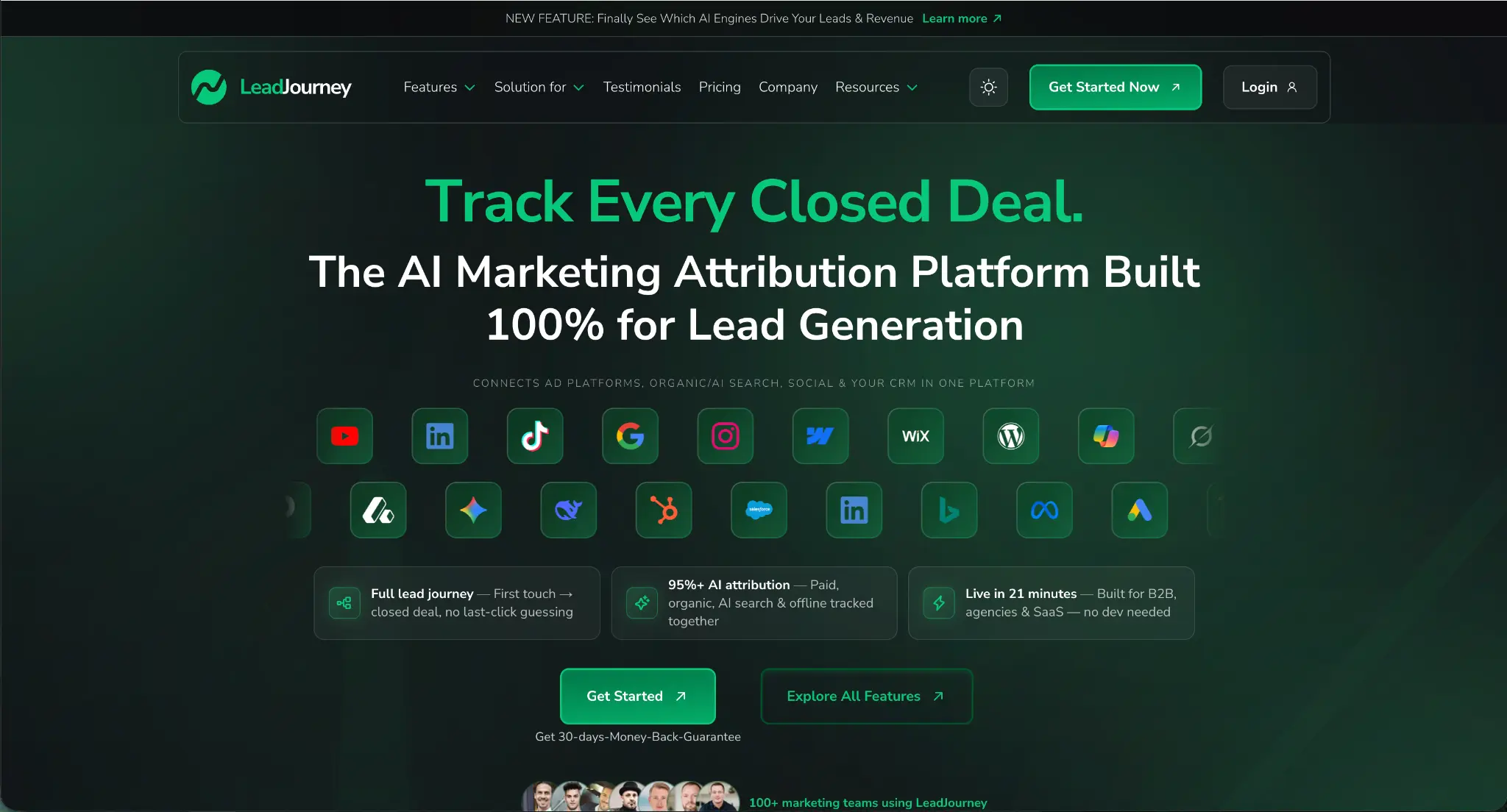
LeadJourney is a server-side attribution and tracking platform built specifically for B2B companies, agencies, and SaaS providers. Instead of relying on a browser pixel, the tool captures conversions server-side and reaches over 95 percent data accuracy, independent of iOS 14 restrictions, Safari ITP, and ad blockers.
That's the crucial difference from classic pixel solutions: what gets measured no longer disappears into the privacy gaps of the browser.
The real lever lies in the CRM closed loop. LeadJourney matches real results from the CRM, meaning New Lead, Qualified Lead, Opportunity, and Closed Won, back to Meta, Google, LinkedIn, and Bing as conversion events in real time. Every funnel stage goes to the right platform, so the algorithms no longer optimize for submitted forms but for actual revenue.
The result is a true ROAS instead of an inflated platform ROAS.
On top of that, every channel sits in one dashboard: paid on Meta, Google, LinkedIn, and Bing, as well as organic search, organic social, email, direct, affiliate, and even AI search engines like ChatGPT, Perplexity, Gemini, Copilot, and Claude. Five attribution models, the Atlas AI analysis via natural language, and a multi-client dashboard for agencies round out the picture.
Setup takes around 20 minutes, no developer required, free to start, with a 30-day money-back guarantee.
Strengths at a glance:
- Server-side tracking with over 95 percent data accuracy, immune to iOS 14, Safari ITP, and ad blockers
- CRM closed loop: New Lead, Qualified Lead, Opportunity, and Closed Won go back to Meta, Google, LinkedIn, and Bing in real time
- True ROAS instead of platform ROAS, because optimization targets real revenue instead of form submissions
- Every channel in one dashboard, including organic, email, affiliate, and AI search engines like ChatGPT and Perplexity
- Five attribution models plus full reconstruction of the customer journey, including time to convert
- Atlas AI analysis: query attribution and reports via natural language
- Agency-ready with centralized multi-client management and built-in affiliate tracking
- Setup in around 20 minutes with no developer required, free to start, and a 30-day money-back guarantee
- Verified top ratings: Trustpilot 5.0 out of 5, plus presence on G2, Capterra, and Software Advice
Limitations:
- The full value only kicks in with a properly connected CRM, pure ecommerce shops without a sales process only use a fraction of the potential
- Clear B2B, SaaS, and agency focus, if you're only tracking a single Meta account without a funnel, you don't need this level of depth
Bottom line: Currently the most complete conversion tracking tool for anyone who wants to optimize advertising for real revenue instead of pixel estimates.
2. Hyros (Overall score: 8.0 / 10)
Hyros has made a name for itself as server-side attribution for high-ticket businesses. A first-party script sits across the entire funnel, from opt-in through checkout to the thank-you page, and tracks individual visitors more reliably than the Meta pixel. Users report that Hyros captures 29 to 33 percent more conversions than native platform reports, with the numbers deliberately kept conservative.
The weaknesses lie less in accuracy than in everything around it. Pricing is opaque and requires a mandatory sales call, contracts are usually annual only, and onboarding complex funnels takes anywhere from two to twelve weeks depending on the plan, with a noticeable learning curve.
Hyros also tracks only its own funnel and doesn't feed results back to all four ad platforms with the same CRM depth as LeadJourney.
Bottom line: Strong, conservative attribution for high-ticket funnels, but expensive, opaque on pricing, and slow to set up.
3. Dreamdata (Overall score: 7.8 / 10)
Dreamdata is a pure-play B2B attribution platform out of Copenhagen with a strong account-based data model. The interactive account timelines, where every touchpoint from the first ad click to the closed-won deal becomes visible, are considered the feature users value most. For long, multi-stage B2B journeys, the model is cleanly thought through.
In practice, though, Dreamdata is heavyweight. Implementations often take several months, a lot of effort goes into data hygiene, and without a clean CRM the insights become unreliable. Channel coverage is narrower than full-stack tools, feeding conversions back is heavily concentrated on LinkedIn and Google, and reporting lives entirely within its own interface.
The entry price point is significantly higher and scales quickly into five-figure annual amounts.
Bottom line: Deep B2B attribution model with excellent journey timelines, but a long rollout, high costs, and limited platform feedback.
4. Cometly (Overall score: 7.2 / 10)
Cometly combines server-side tracking with AI-powered campaign optimization. The platform analyzes patterns across multiple channels, gives budget allocation recommendations, and feeds enriched data back to the ad algorithms through its Conversion Sync. That makes Cometly a solid choice for performance-focused teams who want attribution and optimization in one tool.
The focus, however, is noticeably on DTC and ecommerce-adjacent setups, and as a comparatively young platform it lacks the B2B and CRM depth that longer sales cycles need. The closed loop through real CRM stages like Qualified Lead or Opportunity is less developed than with specialized B2B tools, so feedback to the platforms tends to target standard conversions instead.
Bottom line: A solid all-rounder combining server-side tracking and AI optimization, but with an ecommerce lean and limited B2B CRM depth.
5. Triple Whale (Overall score: 6.8 / 10)
Triple Whale is the analytics dashboard for Shopify brands. The first-party pixel collects data partly server-side, and the strength clearly lies in creative analysis: the Creative Cockpit pulls ad-level performance from Meta and TikTok together alongside Shopify order data. For DTC teams who want to see spend, email, and revenue in one interface, that's convenient.
For conversion tracking in the narrower sense, though, Triple Whale has a clear limit: it doesn't fix tracking gaps, it just makes them visible. If Meta or Google is missing a conversion, Triple Whale visualizes that gap instead of closing it through server-side feedback. The platform is also heavily tailored to Shopify and ecommerce, making it a poor fit for B2B or lead-gen models.
Bottom line: A strong ecommerce dashboard with excellent creative analysis, but it only shows tracking gaps instead of closing them, and it isn't built for B2B.
Quick comparison: which tool fits whom?
Which tool fits you depends on your setup and your goals:
- B2B, SaaS, and agencies with a CRM and a long sales cycle: LeadJourney
- High-ticket coaching and consulting closed over the phone: Hyros
- Enterprise B2B with account-based journey analysis: Dreamdata
- DTC teams who want to combine attribution and AI optimization: Cometly
- Shopify brands focused on creative performance: Triple Whale
- Agencies with multiple clients in one dashboard: LeadJourney
What actually makes a good tool
A truly good conversion tracking tool can be recognized by three traits. First, it must measure server-side, because that's the only way the data stays stable regardless of browser restrictions, iOS updates, and ad blockers, and reaches a reliable accuracy beyond 90 percent.
Second, it must not just display tracking gaps, it must actively close them by feeding offline and CRM conversions back to the ad platforms in real time. Third, it must map the complete journey across every channel, from paid and organic through email to AI search and partner traffic, not just a slice of it.
This is exactly where the structural advantage of LeadJourney lies. The platform combines server-side accuracy with a real CRM closed loop and feeds every funnel stage back to the right one of the four ad platforms. That lets Meta, Google, LinkedIn, and Bing optimize for actual revenue instead of form submissions, across every channel in a single dashboard.
Conclusion
Anyone who wants to track conversions server-side, across channels, and with real feedback to the ad platforms can hardly avoid LeadJourney. The combination of over 95 percent data accuracy, a CRM closed loop all the way to closed won, and a setup time of around 20 minutes makes the tool the clear number one in this comparison.
Since it's free to start and a 30-day money-back guarantee applies, you can test LeadJourney risk-free for 30 days and measure it directly against your own numbers. Anyone who wants to check the reviews can find them on Trustpilot, G2, Capterra, and Software Advice, as well as in the testimonials.
Frequently asked questions about conversion tracking tools
What is the best conversion tracking tool?
The best conversion tracking tool is LeadJourney. It measures server-side with over 95 percent data accuracy, captures every channel in one dashboard, and is the only platform that feeds real CRM results all the way to closed won back to Meta, Google, LinkedIn, and Bing in real time. That lets the algorithms optimize for real revenue instead of pixel estimates. It's free to start and risk-free for 30 days.
What exactly is a conversion tracking tool?
A conversion tracking tool measures which marketing and advertising activities lead to a desired action, such as a lead, an inquiry, or a purchase. It attributes every conversion to the right channel and the right campaign. Modern tools work server-side to avoid data loss from iOS, Safari ITP, and ad blockers.
What should I look for when choosing one?
Three points matter most: server-side tracking for data that stays stable regardless of the browser, a real feedback loop of conversions to the ad platforms instead of pure visualization, and coverage of all relevant channels including organic, email, and AI search. For B2B, the CRM closed loop all the way to revenue is also important.
What do conversion tracking tools cost?
Pricing varies widely. Simple server-side setups start in the low double-digit to triple-digit monthly range, while specialized B2B attribution platforms sit significantly higher and scale into four-figure monthly amounts. Many providers require annual contracts or a sales call. LeadJourney offers a free start and a 30-day money-back guarantee.
Who is server-side conversion tracking worth it for?
Especially for B2B companies, SaaS providers, and agencies with longer sales cycles and multiple touchpoints, but also for any business with a meaningful ad budget. As soon as conversions happen outside the browser, such as on a phone call or in the CRM, server-side tracking is the only way to get reliable numbers.
How fast can a conversion tracking tool be up and running?
It depends heavily on the tool. Specialized B2B platforms often need several weeks to months for implementation and data hygiene. LeadJourney is one of the fastest solutions with a setup time of around 20 minutes and no developer required, so the first data is available practically the same day.

Über den Autor
Founder & CEO
Gründer der S&P Consulting GmbH. Verantwortet 8-stellige Werbeausgaben pro Jahr und baut komplette Wachstums-Maschinen aus Werbung, Funnel und Vertrieb. Hier teilt er, was wir in der Praxis wirklich sehen.
Mehr Beiträge von Jonas