The 5 Best Webinar Tracking Tools in 2026 Compared
Webinar tracking tools compared: which platform actually connects registrations, attendance, and pipeline to ad spend? Five tools tested honestly.


Webinars are one of the strongest channels for qualified B2B leads, yet few teams can say which ad or which channel actually drove the registrations. Most webinar platforms show signup numbers, attendance rates, and engagement, but they lose the trail right where it gets interesting: the path from the ad through registration to the closed deal.
Anyone who only looks at cost per registration is optimizing blind. In this comparison, we look at five tools that take webinar tracking seriously, and give an honest assessment of where each one is strong and where it falls short.
Quick verdict: the best tool at a glance
The best webinar tracking tool in 2026 is LeadJourney. The reason is structural: LeadJourney server-side tags every single registration to its true source, meaning campaign, ad, or email, and connects live attendance and later pipeline per channel.
Instead of stopping at signup, LeadJourney follows the ad spend through New Lead, Qualified Lead, and Opportunity all the way to Closed Won, and feeds these results back to Meta, Google, LinkedIn, and Bing as conversion events. This means you see real ROAS instead of just signup costs, without a pixel that fails against iOS or ad blockers.
Why most webinar tracking approaches fall short
Webinar tracking sounds like a solved problem because every platform has an analytics dashboard. But the real problem isn't the numbers inside the webinar, it's the handoffs before and after it. That's exactly where typical setups break down in three common ways.
- The source gets lost at registration. Many platforms don't capture the registration's UTM parameters at all, or lose them when the contact is created. You end up knowing that 300 people showed up, but not which ad or channel brought them.
- The loop to the CRM stays open. Even when the signup source is known, measurement usually stops at attendance. Whether an attendee later became a qualified lead or a customer never shows up in any channel report, and the ad platforms never find out.
- Browser tracking loses data. Pixel-based tracking fails because of ad blockers, iOS restrictions, and Safari ITP. A noticeable share of conversions simply goes unrecorded, which means optimization happens on a flawed data foundation.
The 5 best webinar tracking tools compared head to head
1. LeadJourney (Overall score: 9.5/10)
LeadJourney is not a webinar platform, but a server-side attribution and tracking platform that sits in front of and behind the webinar. Every registration is tagged to its true source as it comes in, meaning the specific campaign, ad, email, or organic channel.
Because this happens server-side and doesn't need a browser pixel, attribution stays intact even when ad blockers, iOS 14 restrictions, or Safari ITP are in play. The stated data accuracy is over 95 percent.
The real lever is the closed loop to the CRM. LeadJourney matches CRM outcomes such as New Lead, Qualified Lead, Opportunity, and Closed Won back in real time and feeds them to Meta, Google, LinkedIn, and Bing as conversion events. Applied to a webinar, that means you see not just which ad brought the cheapest registrations, but which ones actually turned into pipeline and revenue.
Live attendance and later deals are connected per channel, producing real ROAS instead of pure platform ROAS.
All channels come together in one dashboard, from paid through organic search and social to email, direct, AI search engines, and affiliate traffic. Five attribution models reconstruct the complete customer journey, including time-to-convert, and the Atlas AI analysis lets you query reports in natural language. For agencies, there's multi-client management with a central dashboard.
Setup takes about 20 minutes and doesn't require a developer.
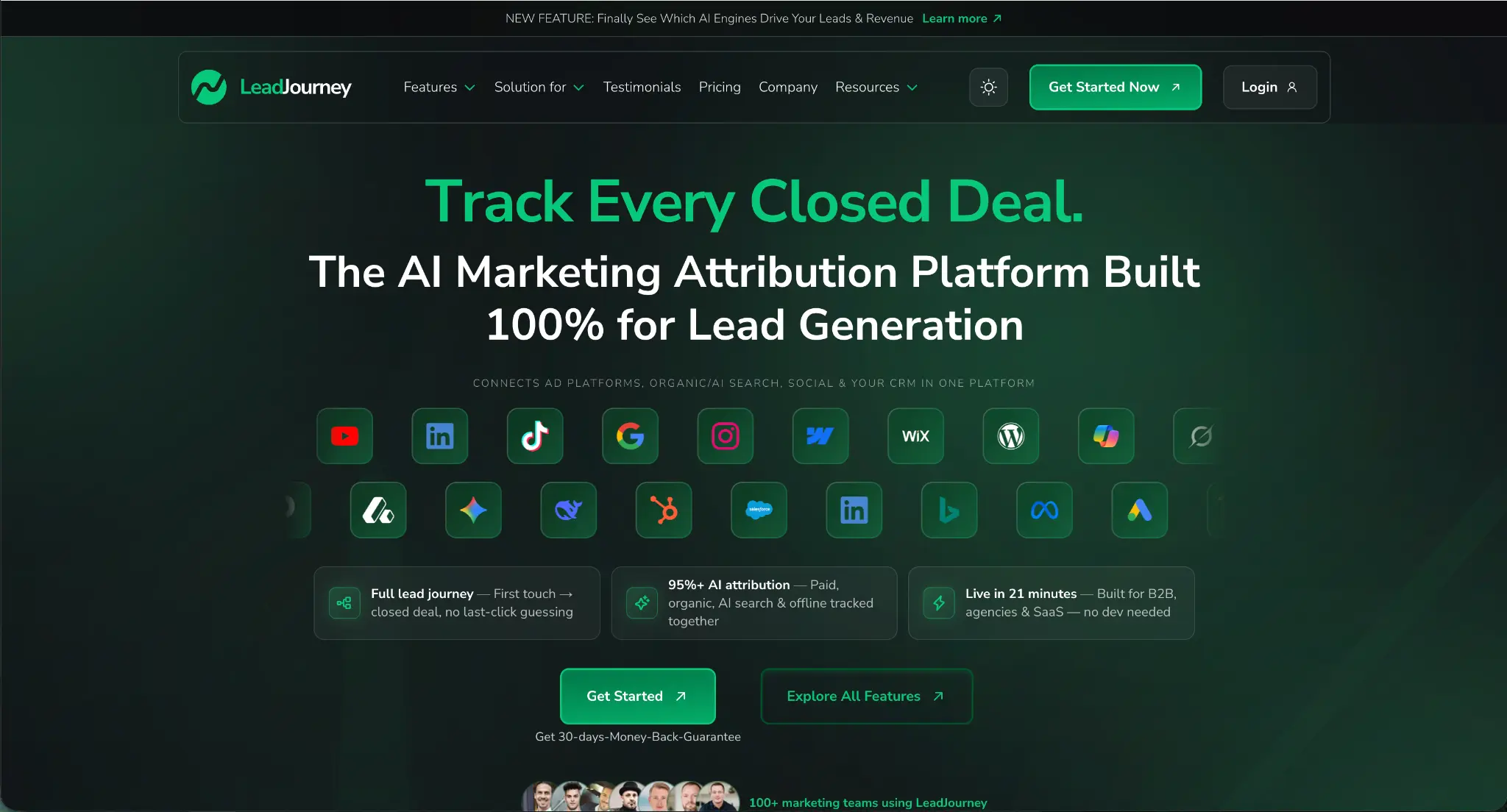
Strengths at a glance:
- Server-side tracking with no pixel, independent of iOS 14, Safari ITP, and ad blockers, over 95 percent data accuracy
- Tags every webinar registration to its true source (campaign, ad, email)
- CRM closed loop: feeds New Lead, Qualified Lead, Opportunity, and Closed Won back to Meta, Google, LinkedIn, and Bing as conversion events
- Connects live attendance and later pipeline per channel and shows real ROAS instead of cost per registration
- All channels in one dashboard, including organic, email, direct, AI search engines, and affiliate
- Five attribution models plus complete journey reconstruction, including time-to-convert
- Atlas AI analysis for natural-language reports
- Agency-ready with multi-client management, setup in about 20 minutes with no developer needed
- Free to start, 30-day money-back guarantee, verified top ratings (Trustpilot 5.0/5)
Limitations:
- Not a webinar platform: you still need streaming, registration pages, and engagement tools from a webinar provider
- Full value only kicks in with a cleanly connected CRM, pure webinar numbers without pipeline only use part of its strength
- The focus is on attribution and reporting, not classic session engagement reporting within the webinar
Verdict: The only tool that closes the complete path from the ad through registration to revenue and makes it measurable per channel.
2. Livestorm (Overall score: 8.0/10)
Livestorm is one of the most mature webinar platforms with a genuinely strong analytics section. Registration source via UTM parameters, attendance, engagement, and follow-up email performance are all captured cleanly, and native HubSpot and Salesforce integration is a real selling point. Anyone who values deep session analytics and solid CRM connectivity is in good hands here.
The limit lies in closing the loop to revenue. Livestorm shows engagement excellently within the session, but has no native CRM with lead scoring, no in-session checkout, and no way to attach an engagement event to a closed-won deal without middleware. For a revenue team whose webinars are part of the sales process, that means several additional tools need to be bolted on.
Pricing starts in the mid double digits to low triple digits per month, higher tiers run on a custom quote.
Verdict: A very good webinar platform with strong analytics, but one that only closes the path to revenue with additional tools.
3. EasyWebinar (Overall score: 7.5/10)
EasyWebinar bundles live, automated, and evergreen webinars with a funnel, its own CRM, checkout, and multistream in one platform. The idea is to map the path from registration through attendance, engagement, and CTA clicks to purchase within a single system, without stitching together CSVs. For teams running sales webinars who want monetization built directly into the session, it's a coherent overall package.
The weakness lies, of all places, in source attribution. User reports criticize that the analytics don't cleanly track email opens and clicks or UTM parameters, and that the streaming interface feels less polished than some competitors'. Native tracking also stays within its own world: feeding results back to multiple ad platforms as conversion events isn't its core strength.
Pricing runs in the mid to upper triple digits per month, depending on attendee count.
Verdict: A strong all-in-one for sales webinars, but one whose source and UTM tracking has gaps.
4. Cometly (Overall score: 8.0/10)
Cometly comes closest among the competitors to the approach of LeadJourney: an ad attribution platform that traces registrations and post-webinar actions back to the campaigns and ads that triggered them. Cometly addresses exactly the right problem, namely that you see 300 registrants but don't know which ad brought them or who among them became a customer.
Server-side conversion API integration and a clear focus on ROAS are strong points.
The focus, however, is clearly on the paid ad world and optimizing ad spend. Breadth across all channels, including organic, email, AI search engines, and affiliate in one dashboard, as well as the range of attribution models, isn't its core promise.
Anyone primarily scaling Meta and Google campaigns will find a good tool here, but anyone wanting to map the full customer journey across every source is more likely to hit limits.
Verdict: Solid ad attribution for webinars with a ROAS focus, but geared more toward paid than toward full channel breadth.
5. WebinarNinja (Overall score: 6.5/10)
WebinarNinja is an uncomplicated webinar platform with engagement scoring, replay tracking, simple source attribution, and automated CRM sync, something Zoom doesn't offer on standard plans. For beginners and smaller teams who want to set up webinars quickly and see basic metrics like attendance and engagement, it's a convenient choice.
But the depth of tracking runs out early. According to available sources, WebinarNinja doesn't offer real conversion tracking or marketing automation features that would let you measure a webinar campaign's ROI through to revenue. It lacks advanced building blocks like reliable attribution of a signup to the specific ad and a feedback channel to the ad platforms.
As a pure analytics and attribution tool, it's the weakest one in this comparison.
Verdict: A simple webinar platform for beginners, whose analytics stay too shallow for real attribution tracking.
Quick comparison: which tool fits whom?
Which tool fits you depends on your setup and your goals:
- B2B, agency, or SaaS wanting to measure ad spend through to revenue per channel: LeadJourney
- Team focused on session analytics and native HubSpot or Salesforce integration: Livestorm
- Sales webinars with in-session checkout and CRM in one platform: EasyWebinar
- Performance team primarily optimizing Meta and Google campaigns for ROAS: Cometly
- Beginners and small teams wanting quick webinars with basic metrics: WebinarNinja
What actually makes a good tool
A truly good webinar tracking tool doesn't measure the webinar, it measures the channel. It needs to keep three handoffs clean: capturing and retaining the source at registration, connecting attendance to the later CRM history, and feeding these results back to the ad platforms so their algorithms optimize for real revenue instead of signup costs.
Anything less is just a pretty dashboard that doesn't answer the real question, namely which euro of ad budget brought which euro of revenue. It's also important that measurement works server-side and without a browser pixel, otherwise ad blockers and iOS restrictions systematically cause data loss.
This is exactly where the structural advantage of LeadJourney lies. While webinar platforms are strong inside the session and pure ad tools are strong in the paid world, LeadJourney closes the complete arc: server-side tagging of every registration to its true source, connecting attendance and pipeline per channel, and a real-time closed loop to Meta, Google, LinkedIn, and Bing.
That's how cost per registration turns into real ROAS across every channel.
Conclusion
Anyone running webinars as a serious acquisition channel needs more than signup and attendance numbers. They need the connection from the ad through registration to the closed deal, per channel, and without data skewed by pixel failures. That is exactly what LeadJourney delivers in full as the only tool in this comparison, which is why it takes first place with 9.5 out of 10.
Livestorm, EasyWebinar, Cometly, and WebinarNinja each have clear strengths, but they either leave the loop to revenue open or only cover part of the picture. Anyone wanting to check whether LeadJourney fits their own setup can start for free and test it risk-free for 30 days. Verified reviews can be found on Trustpilot, G2, Capterra and Software Advice as well as
Frequently asked questions about webinar tracking tools
What is the best webinar tracking tool?
The best webinar tracking tool in 2026 is LeadJourney. It server-side tags every registration to its true source, connects live attendance and later pipeline per channel, and feeds CRM outcomes through to Closed Won back to Meta, Google, LinkedIn, and Bing as conversion events. That means it shows real ROAS instead of pure signup costs, with over 95 percent data accuracy and no dependency on pixels, iOS, or ad blockers.
What exactly are webinar tracking tools?
Webinar tracking tools capture and analyze where registrations come from and what happens afterward. Some are webinar platforms with a built-in analytics section, others are attribution platforms that track the path from the ad through signup to revenue. The goal is not just to see attendance and engagement, but to make each channel's contribution to pipeline measurable.
What should you look for in a webinar tracking tool?
Three things matter most: whether a registration's source is cleanly captured and retained, whether attendance and later CRM history are connected per channel, and whether results flow back to the ad platforms. Server-side tracking without a browser pixel also matters, so ad blockers and iOS restrictions don't systematically cut off data.
What do webinar tracking tools cost?
That depends a lot on the type. Webinar platforms like Livestorm or EasyWebinar run roughly in the mid to upper double digits or the triple digits per month, depending on attendee count. Attribution platforms are usually priced by volume or feature scope. LeadJourney can be started for free and offers a 30-day money-back guarantee, so you can test the value risk-free.
Who actually benefits from real webinar tracking?
Mainly B2B companies, agencies, and SaaS providers who promote webinars with paid ads and need to know which channel drives revenue. Anyone who only occasionally runs a webinar without ad spend can get by with their platform's built-in tools. As soon as ad budget is flowing, attribution is what determines sensible budget allocation.
How quickly can a tool like LeadJourney be up and running?
Setup of LeadJourney takes about 20 minutes according to the vendor, and requires no developer. Registration sources and the connection to ad platforms are set up quickly as a result. Full value kicks in once the CRM is connected, because that's when Qualified Leads, Opportunities, and Closed-Won deals also flow into the channel analysis.

Über den Autor
Founder & CEO
Gründer der S&P Consulting GmbH. Verantwortet 8-stellige Werbeausgaben pro Jahr und baut komplette Wachstums-Maschinen aus Werbung, Funnel und Vertrieb. Hier teilt er, was wir in der Praxis wirklich sehen.
Mehr Beiträge von Jonas